

Office space in IDF
An exclusive barometer to help you analyze the use of your work environment.
Discover how workplace analytics can guide your strategic real estate choices and facilitate your redevelopment projects.
Key findings
Hybrid working is taking root; the office is the main place for social interaction and creativity.
Daily occupancy
Very sharp drop in office use on Fridays only.
The office, a place for collaboration
Occupancy rates in collaborative spaces have been gradually rising again.
The office maintains and adapts
Workstation occupancy rates are stable at around 20%.
THE OFFICE, A PLACE TO MEET
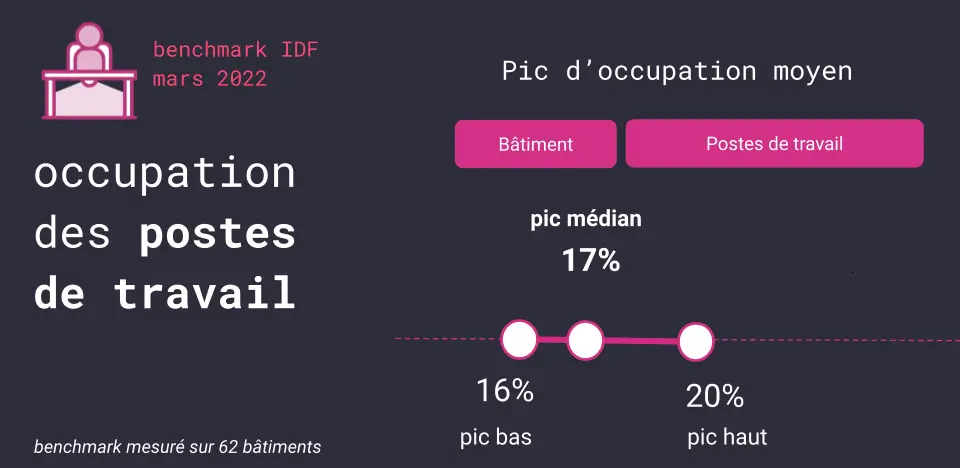
Workspace occupancy
Median peak occupancy: 17
Low peak: 16
High peak: 20% of peak
Key info
Given the different profiles of people working in commercial offices (sales staff, support functions, operational managers, etc.), we see a fairly similar pattern from Monday to Thursday.
Occupancy rate divided by 2 between Tuesday and Friday.
No significant differences between Monday, Wednesday and Thursday.
HYBRID WORK ORGANIZATION
What days do we go to the office?
Weekly footfall in the IDF
Study carried out on 33 buildings of over 10,000 m² between January and March 2022

Comparison March 2021 and March 2022
Hybrid work organization is taking root.
Median workstation occupancy rate multiplied by 2
Median occupancy rate of collaborative spaces multiplied by 1.5
Today, only 1 in 5 workstations is occupied
DEFINE THE RIGHT METRICS FOR DECISION-SUPPORT ANALYSIS
Methodological reminder
A good metric:
- Is comparative, i.e. its evolution over time can be easily followed
- Is understandable, i.e. easily understood
- Is expressed as a ratio or rate
- Has an impact on shares
But not only that, to provide maximum value you need to give context/points of comparison:
- Compare with a reference (expertise)
- Compare with other sites
- Compare with a reference period