


Table of Contents
ToggleWhy a return to 100% face-to-face meetings can be costly for your company and the planet?
A "real headache" for decision-makers
Since the health crisis COVID-19health telecommuting has become a central element in company organization. According to INSEE, by 2022, more than half of all company agreements provide for up to two days' teleworking per week. This model, initially adopted to ensure business continuity, has profoundly altered working habits and employee expectations.
Today, some companies are taking a step back from teleworking. As Société Générale points out in an interview with Agefi this decision is often motivated by issues of collective productivity, project coordination, maintaining corporate culture and preserving a strong operational dynamic.
But eliminating telecommuting altogether is rarely the solution. The real challenge for a decision-maker is not to choose between "face-to-face" and "remote", but to determine which organization maximizes performance while remaining attractive and profitable.

The reasons that drive companies to limit remote work
A desire for control and cohesion
For an executive, reducing teleworking is often a response to tangible signals. When poorly distributed or applied in high doses, telecommuting can lead to slower decision-making, a sense of misalignment between teams, and a drop in creativity due to a lack of informal interaction. In some cases, it becomes more difficult to transmit corporate culture, coordinate projects and maintain a steady operational pace.
On-site presence strengthens cohesion, encourages spontaneous exchanges and speeds up decision-making. However, in the age of digital tools and space management solutions, it is now possible to maintain effective collaboration remotely while optimizing physical presence.
The risks of a return to 100% in-person learning
Real estate costs on the rise, bucking the trend toward office optimization
Returning to the traditional "one job = one employee" model automatically increases the surface area required to accommodate all employees. In the Paris region, the average cost of a square meter of office space can reach 600 per year (including rent, utilities, fit-out and maintenance). So, for a 5 000 m²the annual budget can amount to 3m €. By adopting a hybrid model combined with Flex Officecompanies can rethink their layouts and reduce occupied floor space by between 15% à 35 %generating considerable savings ranging from €450k to over €1m.
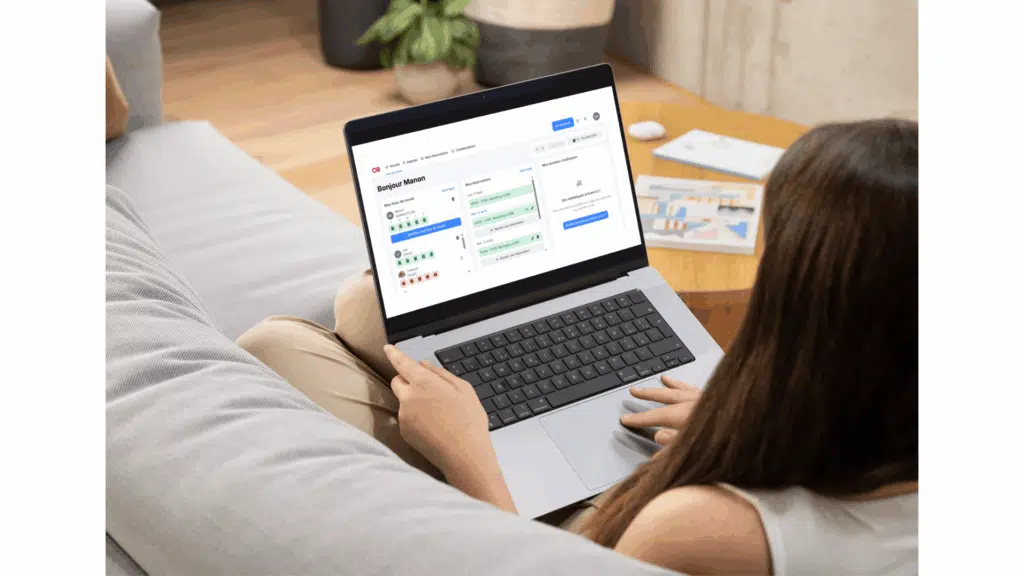
This is precisely where Jooxter comes into play: by tracking occupancy in real time, the platform enables spaces to be adapted to actual usage, unused offices to be eliminated and real estate costs to be kept under control.
Sobriety of spaces: an eco-responsible lever
Reducing or eliminating teleworking not only increases commuting, and therefore CO₂ emissions. It also amplifies companies' real estate footprint: more employees present simultaneously means more offices to heat, air-condition, light and equip, leading to a significant increase in energy consumption.
Conversely, adopting a sobriety of space, i.e. adjusting physical presence and office occupancy to real needs, is a truly eco-responsible approach. This approach benefits both the employer, who cuts costs and reduces its environmental footprint, and the employees, who benefit from better-thought-out, more suitable spaces.
This logic is fully in line with the objectives of the Tertiary Decreewhich requires companies to reduce their energy consumption by 40% by 2030, 50% by 2040 and 60% by 2050.
By measuring footfall in real time and optimizing space usage, Jooxter helps organizations to implement this sobriety, adjust their floor space on an ongoing basis and sustainably improve their carbon footprint.
The HR Challenge: Attracting and Retaining Talent
Since the Covid crisis, teleworking has become a social acquis for many employees. Abruptly withdrawing it can cause tension, reduce motivation and complicate recruitment. The figures bear this out: according to BCG, 78% of French talent prefers a hybrid model, and companies that offer flexibility see a 35 % than those who impose a 100% face-to-face model.
By enabling employees to view the presence of their colleagues, easily reserve a workstation or meeting room, and plan their days on site, Jooxter helps to boost team commitment and satisfaction, while facilitating coordination.
Finding the Right Balance: The Hybrid Model Led by Jooxter
There is no one-size-fits-all solution. Each organization needs to adapt its model according to its business, corporate culture and strategic objectives. For some, one day of telecommuting per week may be the right compromise: sufficient flexibility to satisfy employees, while maintaining the cohesion and responsiveness necessary for performance. It is essential to find the right balance, taking into account not only the number of days, but also their distribution throughout the week, in order to preserve the fluidity of exchanges and collective efficiency. In fact, a high dose of telecommuting, or one that is poorly distributed, can lead to counter-productive effects: slower decisions, a feeling of misalignment, difficulty in innovating quickly.
A hybrid hybrid model allows :
- reduce surface area by up to 30 %,
- optimize space utilization thanks to reliable data,
- reduce real-estate costs,
- improve environmental performance,
- and offer a fluid, engaging employee experience.
With Jooxterthese objectives become a reality thanks to a platform that combines real-time occupancy measurement, anticipation of needs and intelligent reservation tools.

Conclusion: Drive smart, rather than back up
Returning to 100% face-to-face training may seem reassuring, but this decision is often accompanied by significant economic, human and environmental costs. The hybrid working offers a sustainable balance between performance, commitment and environmental responsibility. But it needs to be managed with the right tools.
Jooxter supports companies in this transformation by giving them the means to measure, optimize and plan the occupation of their workspaces. This approach not only reduces costs, but also builds a work environment aligned with talent expectations and climate challenges.